

Trillium general availability made a TPU generation a cloud configuration question
Google Cloud made its sixth-generation Trillium TPU generally available on December 11, 2024, shifting the event from an announced chip to a selectable cloud resource.
Historical reporting: primary documents record this event on 2024-12-11. Vendor statements, planned schedules and comparative figures remain attributed. This retrospective does not infer current availability, price, capacity, performance or support.
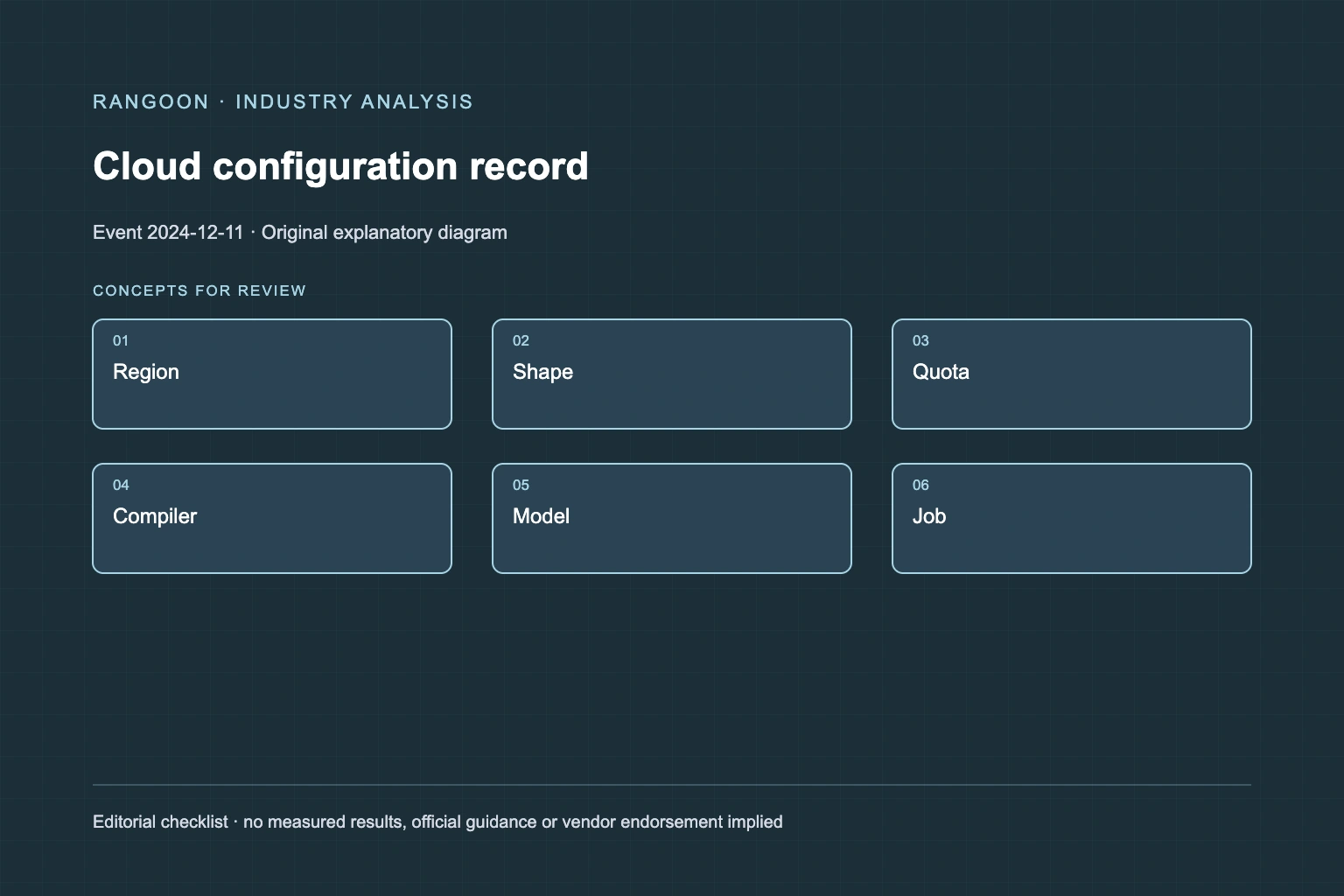
Key takeaways
- Google Cloud announced Trillium, its sixth-generation TPU, was generally available for customers on December 11, 2024.
- A vendor announcement, a plan, an installed system and a completed workload are different evidence states.
- Original analysis: retain configuration and outcome evidence before treating an infrastructure claim as an operating result.
The dated event has a bounded claim[source 1][source 2]
On 2024-12-11, the first primary document recorded this event. Google Cloud announced Trillium, its sixth-generation TPU, was generally available for customers on December 11, 2024. Google described Trillium as offering 4.7 times peak compute per chip relative to TPU v5e and named a 256-chip pod configuration, both vendor comparisons tied to its own platform.
Trillium’s December 2024 GA date changed the question from what Google had announced to what a Google Cloud customer could select. Google’s 4.7-times comparison to TPU v5e and 256-chip pod reference are platform descriptions; they do not identify a fixed compiler, quota or model implementation for every user.
Engineering facts need a workload boundary[source 1][source 2]
General availability establishes a service state for the named offering; it does not mean every region, quota, framework version or model is equally ready. Compiler behavior, sharding, networking and data locality affect a real job.
TPU jobs often combine compiler graph partitioning, sharding, high-bandwidth memory placement and collective operations. A model that fits a 256-chip pod can still fail its intended service objective if tokenization, host input, checkpoint cadence or cross-region data movement is poorly matched to the job shape.
Plans, delivery and use are separate states[source 1][source 2]
A GA assessment should start with the actual machine family shown in a chosen region and account, then compile a small representative model. Include cold compilation, checkpoint restore, a single-host failure and a scale transition. Those cases expose practical constraints that a generational peak-compute figure cannot answer.
Peak compute per chip is useful for hardware comparison but not enough for cost attribution. TPU utilization, compilation time, idle reservation, storage reads, network egress and retried jobs can shift the effective cost of training or serving. Keep those meters next to, rather than inside, the supplier comparison.
Original analysis: make the operating evidence inspectable[source 1][source 2]
Make an availability check explicit: region, machine shape, quota, software stack, model and job class. Then test throughput, tail latency, compilation, checkpoint recovery and cost attribution. Do not replace those measurements with a cross-generation peak-compute comparison.
The historical result is a dated Google Cloud availability record for a sixth-generation TPU. An operator can build on it with current region and quota evidence, but should not make a continuing availability, price or performance claim from this December 2024 release alone.
For Trillium, build a representative job matrix rather than a single large run. Include short and long sequences, different batch shapes, a checkpoint restore and a data-starved case. Record compile time separately from training or inference time, then state whether the selected region and quota were sufficient for each run. That evidence clarifies whether a result comes from the TPU, model partitioning, input pipeline or capacity policy.
Trillium GA gives a dated starting point for cloud selection. It does not answer whether a particular customer had quota, whether its framework graph compiled efficiently, or whether the selected region kept data and dependent services close enough to meet a latency target.
Sources
- Google Blog: Trillium TPUs now available (December 11, 2024)
- Google Cloud Blog: Announcing general availability of Trillium TPU (December 11, 2024)
Continue reading
Related reading
 News analysisNVIDIA’s memory codesign post highlights a practical boundary between capacity and usable agent throughput3 min read
 News analysisNVIDIA supply-chain capacity plans make packaging, test and optics explicit infrastructure constraints3 min read
 News analysisThe Ultra Ethernet Consortium released its 1.0 AI-networking specification3 min read