Magistral made reasoning transparency a traceability question
Mistral announced Magistral on June 10, 2025 as its reasoning family. A visible rationale still needs source checks, output controls, and accountable decisions.
Historical reporting: Mistral’s June 10, 2025 Magistral post announced its reasoning models; the Medium 1.0 documentation is a separate primary record. The analysis below is original editorial analysis; it does not claim present availability, performance, or support.
Key takeaways
- On June 10, 2025, Mistral announced Magistral as its first reasoning-model family, describing open and enterprise versions and emphasizing domain-specific, transparent, and multilingual reasoning.
- If a workflow exposes reasoning or intermediate summaries, classify them as review material.
- Mistral’s June 2025 documents support its stated Magistral positioning. They do not validate the truth of generated rationales or current product availability.
What Mistral presented[source 1][source 2]
On June 10, 2025, Mistral announced Magistral as its first reasoning-model family, describing open and enterprise versions and emphasizing domain-specific, transparent, and multilingual reasoning. The publication framed step-by-step deliberation as a product feature. That framing should not be confused with independent verification of the reasoning or its final conclusion.
The Magistral Medium 1.0 documentation separately records the named version and date. The two sources serve different roles: the post establishes the launch narrative, while the documentation establishes a versioned model reference. Neither makes a generated rationale a source of truth for external facts.
Editorial analysis: use traces as review material
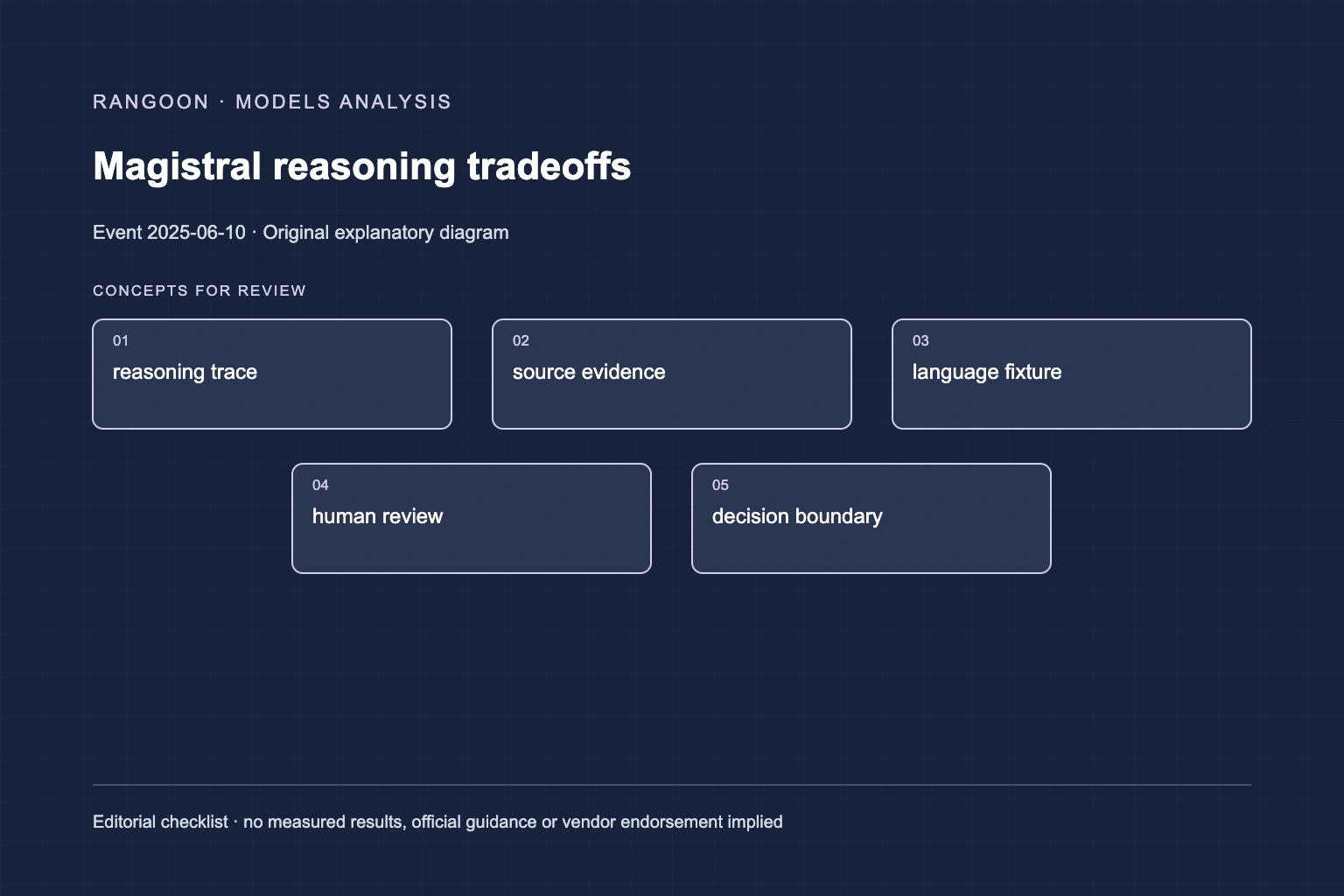
If a workflow exposes reasoning or intermediate summaries, classify them as review material. Preserve the prompt, retrieved evidence, tools used, timestamps, and final answer. A reviewer should be able to check a claim against source data rather than infer truth from fluent intermediate text.
Multilingual tasks need language-specific fixtures. Translation, legal terminology, formats, and refusal behavior can vary by language, so an English-only evaluation cannot establish behavior for another language merely because a release says multilingual.
Editorial analysis: score answers and evidence separately
Build separate checks for factual support, arithmetic or code correctness, instruction following, and explanation usefulness. An answer can be correct with a weak explanation or persuasive with unsupported claims. Separating scores avoids treating transparency as a single quality metric.
For high-impact decisions, define a required evidence threshold and human owner. Reasoning output may help prioritize work, but it should not silently become approval for a payment, policy, medical, legal, or production action.
Editorial analysis: store the decision boundary
Document what the model may draft, what it may recommend, what tools it may call, and which decisions remain human-controlled. Store examples of abstention and escalation as part of the acceptance set.
This creates a useful historical distinction: Magistral’s June release described a reasoning capability; an organization’s operating policy determines whether and how that capability enters a decision process.
Editorial analysis: retain the release boundary
Mistral’s June 2025 documents support its stated Magistral positioning. They do not validate the truth of generated rationales or current product availability.
For a hypothetical multilingual compliance draft, give the model a source bundle in two languages with a local term that has no exact English equivalent. Require the output to preserve the original term, cite the source sentence, and flag uncertainty rather than inventing a normalized meaning. A readable reasoning trace may help a reviewer locate the decision, but the reviewer should still verify the source and chosen translation. This test separates transparent presentation from factual grounding and language competence. It is not a claim about Magistral’s performance; it is a way to test the release’s stated multilingual and transparent-reasoning orientation in a controlled workflow.
When no reliable source is present, the expected result should be an explicit evidence gap. This makes the model’s uncertainty behavior testable instead of rewarding confident but unverifiable prose.
Sources
- Mistral: Magistral (June 10, 2025)
- Mistral Docs: Magistral Medium 1.0
Continue reading