

Meta and Blue Owl formed a Hyperion development joint venture, leaving the Louisiana campus itself under construction
Meta and Blue Owl funds entered a Hyperion data-center joint venture on October 21, 2025, committing development funding while the Louisiana campus remained a construction project.
Historical reporting: Meta announced on October 21, 2025 that it and funds managed by Blue Owl Capital had entered a joint venture to develop and own the Hyperion campus in Richland Parish, Louisiana. Meta’s later third-quarter filing records the venture and contributions. Meta said Blue Owl-managed funds would hold 80%, Meta 20%, with approximately $27 billion in total development costs for buildings and long-lived power, cooling and connectivity infrastructure. Those are transaction and development-funding statements, not an operating-campus receipt. Meta said construction was well underway, but neither record establishes completed buildings, energized power, commissioned cooling, installed compute, a usable AI service, a return, or an investment recommendation.
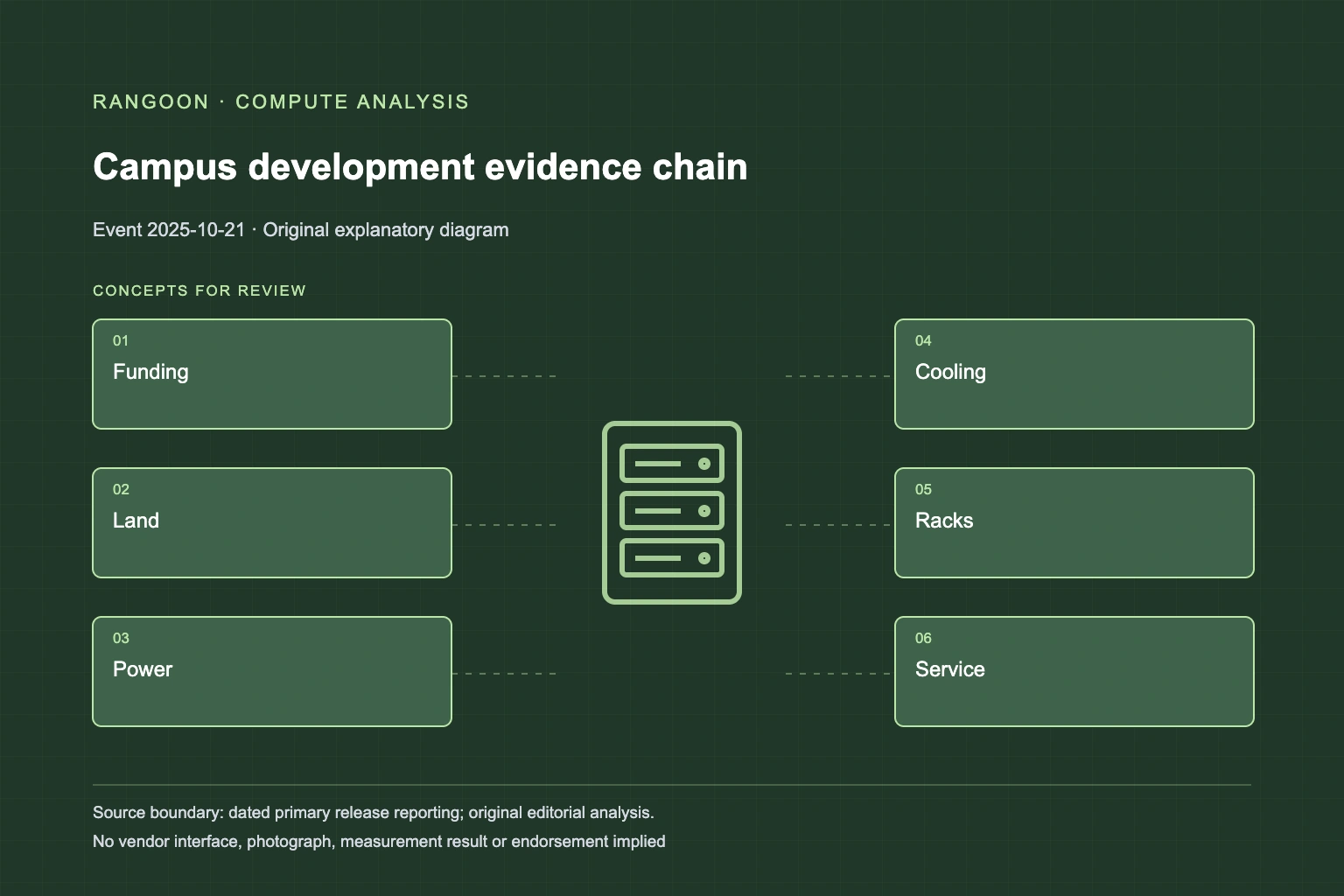
Key takeaways
- October 21 is a joint-venture and funding milestone for a campus under development, not a commissioning announcement.
- The stated ownership and development-cost figures describe the proposed project structure, not live compute capacity or operating revenue.
- Construction progress needs separate evidence for power, cooling, hardware, network, commissioning and workloads.
The October event established a development-and-ownership arrangement for the campus[source 1]
On October 21, 2025, Meta announced that it and funds managed by Blue Owl Capital had entered into a joint venture that would develop and own the Hyperion data-center campus in Richland Parish, Louisiana. Meta said it would provide construction and property management services. This is a corporate and project-financing milestone with a named site and defined roles. It does not say that the joint venture had completed a data hall, delivered racks, turned on servers or made an AI platform available. Meta’s announcement links the partnership to its long-term AI ambitions, but that business rationale is not a measure of current capacity. The proper event label is joint-venture formation for campus development. A reader should keep that legal and financial state separate from construction completion and from a computer system’s operating state.
The reported ownership and development costs describe financing and asset governance, not a capacity benchmark[source 1]
Meta said the Blue Owl-managed funds would own an 80% interest and Meta would retain 20%, with the parties committing their pro rata shares of approximately $27 billion in total development costs for buildings and long-lived power, cooling and connectivity infrastructure. The release also described a Blue Owl cash contribution and a Meta distribution connected with land and construction-in-progress assets. These are company-reported transaction terms. They are useful for explaining who would fund and own the project, but do not state how much compute was installed, what hardware was selected, how many megawatts were energized, or when the campus would serve a workload. Development costs include multiple physical systems over time; they should not be translated into a current price per accelerator, a cloud-service cost, or an investment conclusion about either company.
Meta’s quarterly filing corroborated the venture while retaining the boundary between a deal and an operating site[source 2]
Meta’s quarterly report for the period ended September 30 records that, in October, it entered a joint venture with an affiliate of Blue Owl-managed funds to co-develop a new Richland Parish campus. The filing describes the assets Meta contributed and the investor cash contribution, providing a second primary record of the arrangement. A financial filing can establish that a company recorded a venture and related transactions; it does not supply an engineering acceptance test. The report does not publish a cluster topology, hardware delivery schedule, power-quality record, cooling performance, network turn-up date, service-level objective or customer allocation. Treating the filing as confirmation of the financial structure is appropriate. Treating it as confirmation that a future data center is operating would add facts the document does not provide.
Construction language did not make Hyperion a commissioned AI facility on the agreement date[source 1][source 2]
Meta said construction was well underway and that the project would support its long-term AI ambitions. Those statements establish a reported construction condition and strategic rationale, not a completed system. A rigorous follow-up would identify which buildings were complete, which electrical and cooling systems had passed acceptance, whether utility or generation capacity was energized, what servers and accelerators were installed, and whether any workload had been accepted. Each state has different evidence and failure modes. Even after a building is complete, network fabric, storage, firmware, safety systems and scheduling may delay useful compute. The October announcement supports a clear historical account of a financing and development arrangement. It should not be used to infer delivered megawatts, product performance, operating margins or a recommendation about the parties’ securities.
Sources
- Meta: Meta announces Blue Owl joint venture for Hyperion Data Center (October 21, 2025)
- Meta Investor Relations: Quarterly report for the period ended September 30, 2025 (October 29, 2025)
Continue reading
Related reading
 News analysisNVIDIA’s memory codesign post highlights a practical boundary between capacity and usable agent throughput3 min read
 News analysisNVIDIA supply-chain capacity plans make packaging, test and optics explicit infrastructure constraints3 min read
 News analysisThe Ultra Ethernet Consortium released its 1.0 AI-networking specification3 min read