

Cobalt 200 made host-CPU choice part of an AI infrastructure system
Microsoft announced its Cobalt 200 cloud-native CPU in November 2025, framing the Arm processor alongside Azure Boost and integrated hardware security components.
Historical reporting: primary documents record this event on 2025-11-18. Vendor statements, planned schedules and comparative figures remain attributed. This retrospective does not infer current availability, price, capacity, performance or support.
Key takeaways
- Microsoft announced Cobalt 200 during Ignite 2025 as the successor to Cobalt 100.
- A vendor announcement, a plan, an installed system and a completed workload are different evidence states.
- Original analysis: retain configuration and outcome evidence before treating an infrastructure claim as an operating result.
The dated event has a bounded claim[source 1][source 2]
On 2025-11-18, the first primary document recorded this event. Microsoft announced Cobalt 200 during Ignite 2025 as the successor to Cobalt 100. Its materials described a 3nm Arm CPU with 132 cores and per-core dynamic voltage and frequency scaling, and positioned it with Azure Boost and an Azure-integrated hardware security module.
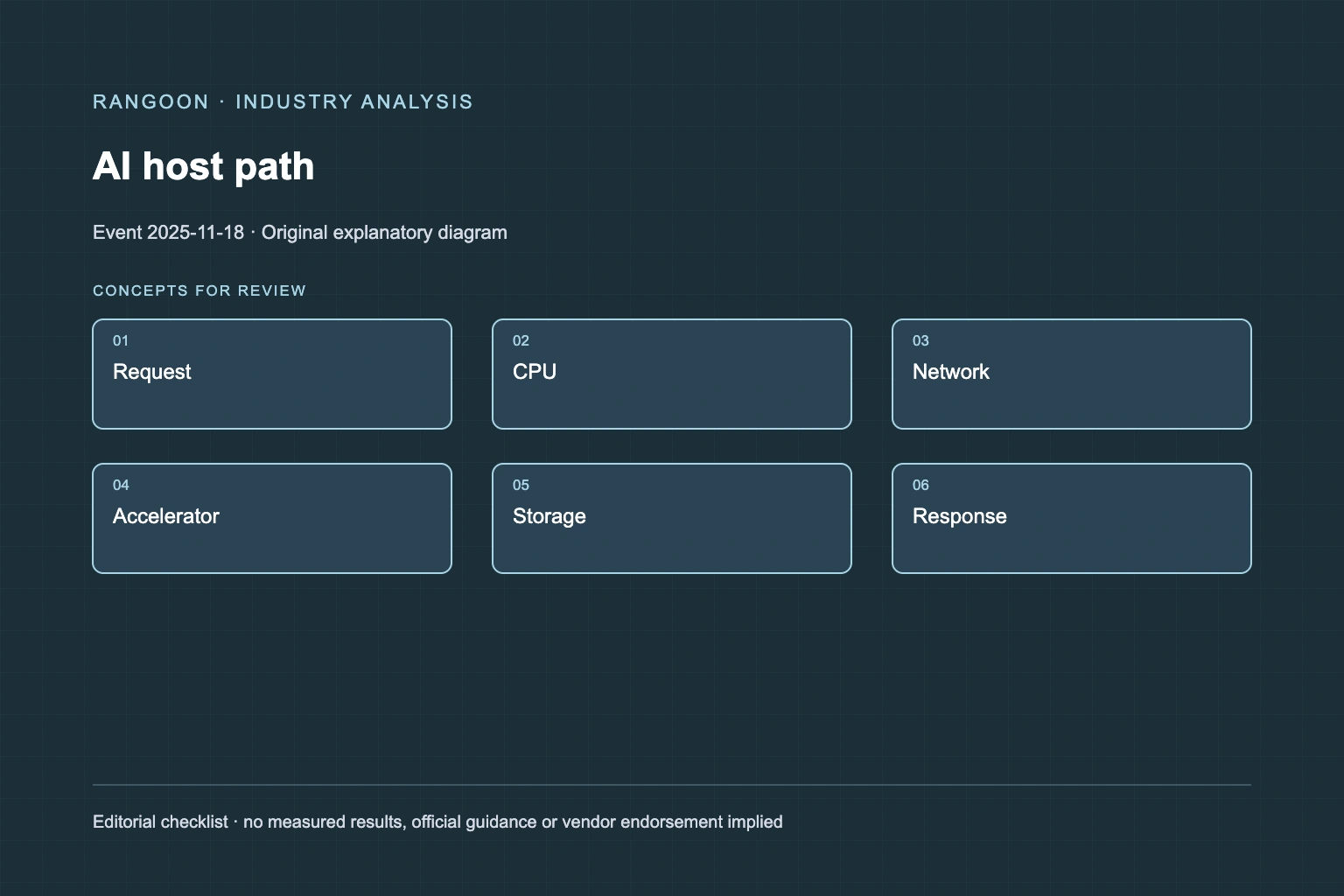
Cobalt 200 was an Arm host CPU event, not an accelerator launch. Microsoft described 132 cores, a 3nm process and per-core DVFS, then placed the chip alongside Azure Boost and an integrated HSM. That combination shows why control, storage and networking infrastructure matter around AI execution.
Engineering facts need a workload boundary[source 1][source 2]
AI services do not run only on accelerators. Tokenization, request routing, retrieval, storage, network handling and orchestration consume host resources, so a CPU announcement is context for a system, not a substitute for an accelerator benchmark.
A retrieval-augmented service can spend substantial time embedding requests, parsing documents, running vector queries, encrypting traffic and assembling outputs before any accelerator kernel starts. A host CPU improvement may help those stages, but it cannot be read as a direct claim about model quality or GPU throughput.
Plans, delivery and use are separate states[source 1][source 2]
Compatibility with Cobalt 100 workloads is a migration statement, not evidence that every container image, language runtime or extension performs identically. A controlled migration should compare compiler targets, operating-system image, storage driver, network interface and request mix before moving a production service.
Per-core DVFS can influence power behavior under uneven web or orchestration load, but a data-center processor’s value also depends on VM sizing, reserved capacity, software licensing and utilization. A 50% supplier improvement claim is not a universal saving for every cloud tenant.
Original analysis: make the operating evidence inspectable[source 1][source 2]
Instrument host and accelerator queues together. Attribute latency to preprocessing, data movement, scheduling, model execution and postprocessing before choosing a CPU or claiming an AI-stack improvement. A lower host bottleneck can expose a different bottleneck downstream.
Cobalt 200 belongs in an AI infrastructure record as a host-path component. Report it with a profile of CPU saturation, queueing and I/O rather than attaching an accelerator-style benchmark. This preserves the November hardware event while avoiding a false model-performance conclusion.
To evaluate Cobalt 200, replay the same API mix on matched VM sizes and collect CPU run queue, network interrupts, storage waits, request parsing time and accelerator idle time. Include bursty and steady traffic because DVFS and orchestration behavior can differ between them. A finding is useful only if it identifies which host-side stage improved and whether the downstream service-level objective changed; raw core count does not answer that question.
Cobalt 200’s most relevant AI role may be ordinary but important: moving, preparing and routing data around accelerators. That makes end-to-end request timing more informative than quoting an Arm CPU improvement outside the workload it was measured against directly.
Sources
- Microsoft Community Hub: Announcing Cobalt 200 (November 18, 2025)
- Microsoft Ignite 2025 Book of News (November 18, 2025)
Continue reading
Related reading
 News analysisMicrosoft announced a planned Pecos campus and dedicated power path, keeping its two-gigawatt figure separate from operation3 min read
 News analysisArm’s Lumex launch made on-device AI a CPU, GPU, system-IP and software-stack choice3 min read
 News analysisTrainium2 availability turned chip claims into an instance-design question3 min read