

NVIDIA launched Cosmos as an open world-model platform for physical-AI data and simulation
NVIDIA launched Cosmos on January 6, 2025, combining world foundation models, tokenizers and data processing for robotics and autonomous-vehicle development.
Historical reporting: NVIDIA launched Cosmos on January 6, 2025 as a platform of generative world foundation models, tokenizers, guardrails, and a video processing pipeline for physical AI. NVIDIA’s research publication says the platform and open-weight models used permissive licenses. These are NVIDIA statements; generated video and simulations are not proof that a robot or vehicle is safe in the real world.
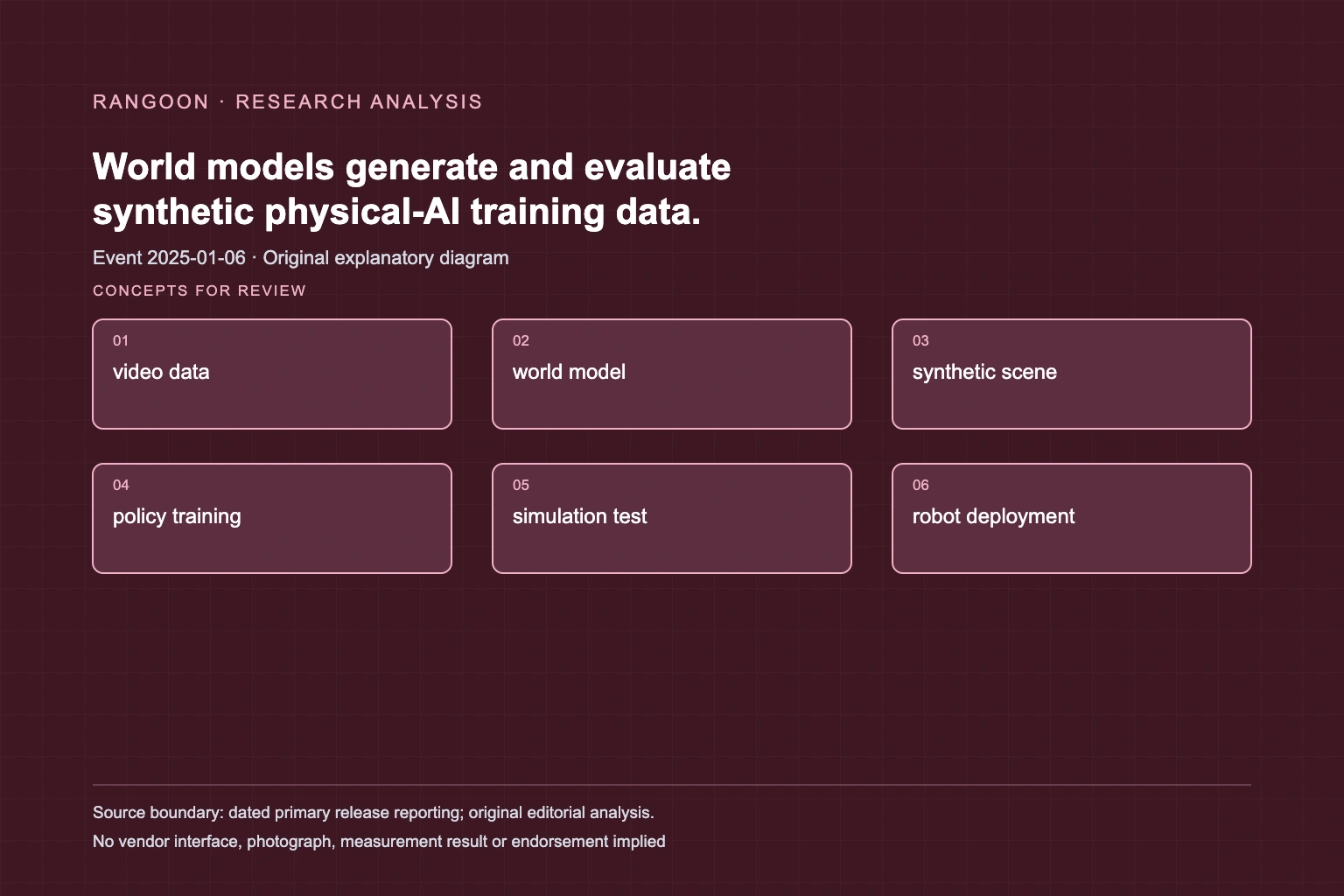
Key takeaways
- Cosmos joined video curation, tokenization, world models and post-training examples for physical-AI development.
- Open weights and permissive licenses affect reuse terms but do not establish fitness for a specific system.
- Synthetic or generated scenarios can extend data coverage while requiring validation against real-world behavior.
The January launch described a platform rather than one robot policy[source 1]
NVIDIA announced Cosmos on January 6, 2025 as a platform for physical AI, comprising generative world foundation models, tokenizers, guardrails, and accelerated video processing. The company positioned it for robotics and autonomous vehicles, where collecting diverse real-world data and testing rare conditions can be expensive. The platform framing matters because world generation, data curation, and a downstream control policy are separate components.
NVIDIA said the first wave of open models was available to developers. That is not proof that a particular robot, vehicle, simulation stack, or customer application was production ready.
World models generate or interpret future scenes from multimodal inputs[source 1][source 2]
NVIDIA said Cosmos models could generate physics-based videos from text, image, video, sensor, or motion inputs. A world-model workflow can turn recorded or structured context into additional scenes for training, testing, or analysis. The resulting pixels are useful only insofar as they preserve the conditions a downstream perception or policy system must handle.
A generated scenario is not automatically a faithful measurement of the physical world. Sensor noise, unusual weather, material interactions, human behavior, and a policy’s closed-loop response can differ from what a model produces.
Open weights and permissive licenses are distribution facts, not deployment evidence[source 2]
NVIDIA’s research publication describes the platform as open source and its models as open weight with permissive licenses. That can let developers inspect, customize, and post-train components for a target application. License availability, however, does not disclose the data needed for a deployment, the hardware budget, or the validation burden for a safety-relevant system.
The research publication frames a world foundation model as a base that can be fine-tuned into customized downstream models. Customization can improve fit to a domain, while also making provenance, evaluation data, and regressions specific to the organization doing the post-training.
Physical-AI simulation is a development input, not a real-world safety verdict[source 1][source 2]
Cosmos can help assemble training and evaluation material, including scenarios that may be difficult to collect repeatedly. NVIDIA’s claims about adoption, realism, or acceleration remain vendor statements unless a deployment publishes its own methodology and results. A model’s generated video should be checked against the purpose it will serve rather than treated as an environmental ground truth.
The January event supports a bounded historical claim about the Cosmos platform and its stated open distribution. It does not prove an autonomous vehicle is safe, a robot policy transfers from simulation, or a generated-world model solves the long-tail conditions of an operational site. A robust program compares generated coverage with logged real cases, then tests the policy in progressively more representative closed-loop conditions. Field tests still decide transfer for each target task.
Sources
- NVIDIA Newsroom: Launches Cosmos World Foundation Model Platform (January 6, 2025)
- NVIDIA Research: Cosmos World Foundation Model Platform for Physical AI (January 6, 2025)
Continue reading
Related reading
 News analysisNVIDIA’s memory codesign post highlights a practical boundary between capacity and usable agent throughput3 min read
 News analysisNVIDIA supply-chain capacity plans make packaging, test and optics explicit infrastructure constraints3 min read
 News analysisTensorRT-LLM 0.17 added Blackwell and an experimental PyTorch workflow3 min read