

DGX Cloud Lepton introduced a compute marketplace with placement as an engineering variable
NVIDIA announced DGX Cloud Lepton on May 18, 2025, describing a platform intended to connect developers with GPU capacity from multiple cloud providers.
Historical reporting: primary documents record this event on 2025-05-18. Vendor statements, planned schedules and comparative figures remain attributed. This retrospective does not infer current availability, price, capacity, performance or support.
Key takeaways
- NVIDIA announced DGX Cloud Lepton on May 18, 2025 as a platform for connecting developers to GPU capacity from NVIDIA Cloud Partners.
- A vendor announcement, a plan, an installed system and a completed workload are different evidence states.
- Original analysis: retain configuration and outcome evidence before treating an infrastructure claim as an operating result.
The dated event has a bounded claim[source 1][source 2]
On 2025-05-18, the first primary document recorded this event. NVIDIA announced DGX Cloud Lepton on May 18, 2025 as a platform for connecting developers to GPU capacity from NVIDIA Cloud Partners. The announcement named providers including CoreWeave, Crusoe, Lambda, Nebius and others, and said Blackwell and other NVIDIA GPUs would be offered through the marketplace.
DGX Cloud Lepton’s May announcement named a marketplace connecting developers with capacity from a list of cloud partners, including CoreWeave, Crusoe, Lambda and Nebius. The event is about discovery and access across a provider network. It does not mean every provider exposes identical GPU generations, regions or service controls.
Engineering facts need a workload boundary[source 1][source 2]
A marketplace can improve discovery but does not erase differences among providers. Region, hardware generation, network, storage, image revision, reservation terms, data residency and support route still shape a workload after capacity is found.
A workload placed through a marketplace still inherits provider-specific network fabric, storage performance, driver image, scheduler and support path. Moving a model from one partner to another can alter collective behavior, checkpoint throughput, data residency and incident response even when the accelerator name is the same.
Plans, delivery and use are separate states[source 1][source 2]
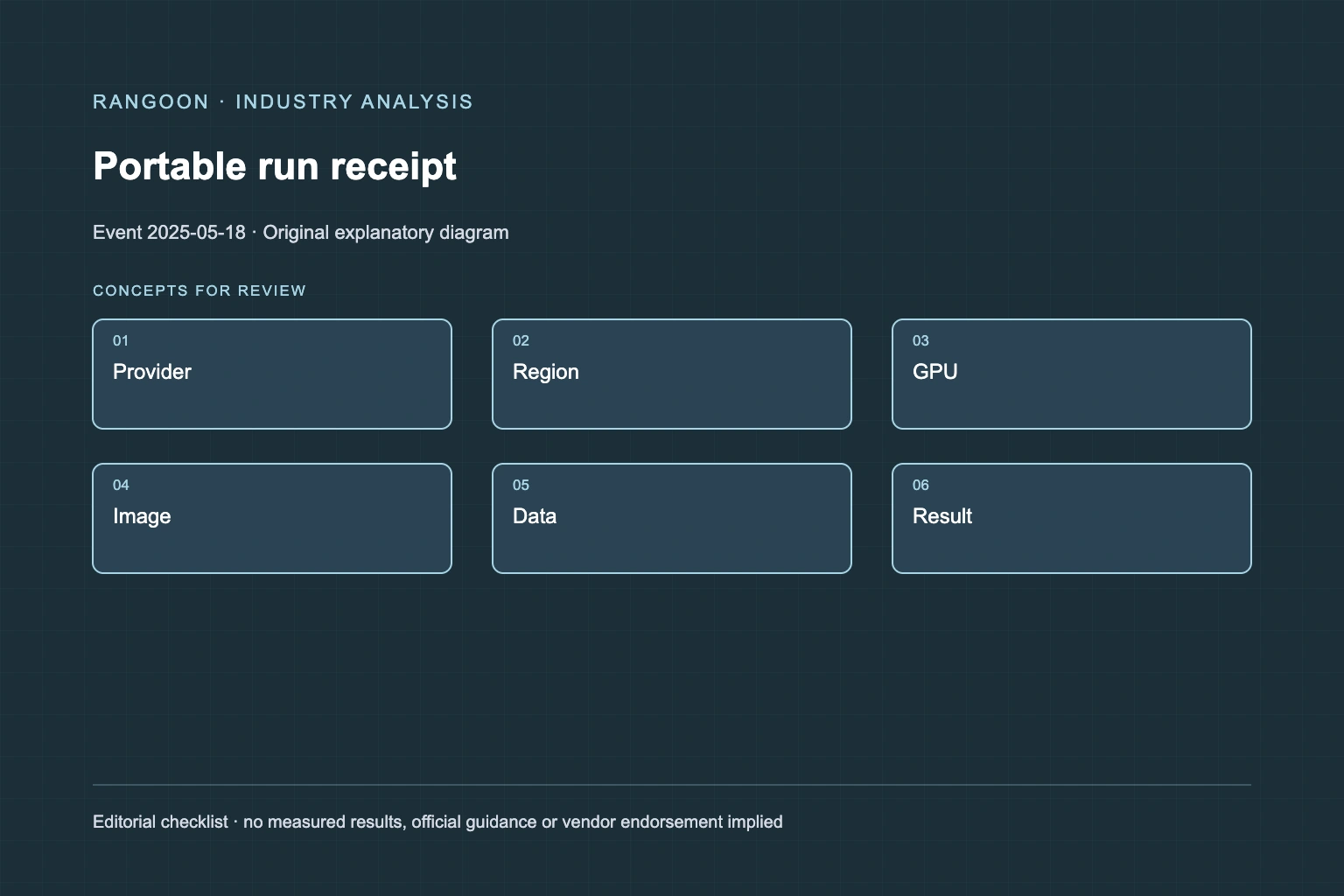
A portable deployment should have an acceptance pack: container digest, driver and framework versions, machine shape, region, storage path, secret boundary and a small correctness fixture. Replaying that pack after a provider change catches differences that a capacity search result cannot reveal.
On-demand and long-term capacity options have different interruption, utilization and commitment risks. Marketplace availability also does not guarantee the quantity needed for a training run at a particular time. Compare reservation terms, data transfer, storage and support with GPU-hour rates before treating an offer as equivalent.
Original analysis: make the operating evidence inspectable[source 1][source 2]
Make placement portable by capturing provider, region, hardware shape, image digest, driver, framework, data path and reservation state in every run receipt. Re-run a small acceptance suite after moving providers; an available GPU is not automatically a comparable execution environment.
The May release supports a marketplace narrative, not a claim of uniform cloud execution. Publish provider placement with every benchmark and keep capacity discovery distinct from an accepted workload. This gives DGX Cloud Lepton a concrete engineering role without overextending its announcement.
For a DGX Cloud Lepton placement, run a small reproducibility suite immediately after provisioning: verify GPU model and count, container hash, driver, network reachability, storage bandwidth and a known model output. Repeat after moving to a different partner or region. Differences should be reported as environment differences, not automatically treated as model regressions. This procedure tests the marketplace promise at the point where a developer actually receives capacity.
DGX Cloud Lepton turns provider selection into part of the experiment. Two runs using the same model and GPU label can remain non-comparable if their regions, storage paths, driver images or reservation states differ, so those fields belong beside every reported result.
Sources
- NVIDIA Newsroom: Announces DGX Cloud Lepton (May 18, 2025)
- NVIDIA Technical Blog: Introducing DGX Cloud Lepton (June 11, 2025)
Continue reading
Related reading
 News analysisNVIDIA’s memory codesign post highlights a practical boundary between capacity and usable agent throughput3 min read
 News analysisNVIDIA supply-chain capacity plans make packaging, test and optics explicit infrastructure constraints3 min read
 News analysisNVIDIA introduced NVLink Fusion for semi-custom AI infrastructure3 min read