

Qwen3-Coder made repository-scale coding claims testable at the tool boundary
Qwen released Qwen3-Coder on July 22, 2025, introducing a 480B-parameter MoE coding model and the Qwen Code command-line tool.
Historical reporting: Qwen’s July 22, 2025 launch announced Qwen3-Coder-480B-A35B-Instruct and Qwen Code. Qwen reports repository-scale context, agentic coding and tool-use benchmarks; those vendor results do not establish correctness, security, licensing, cost or safe authority for a separate codebase.
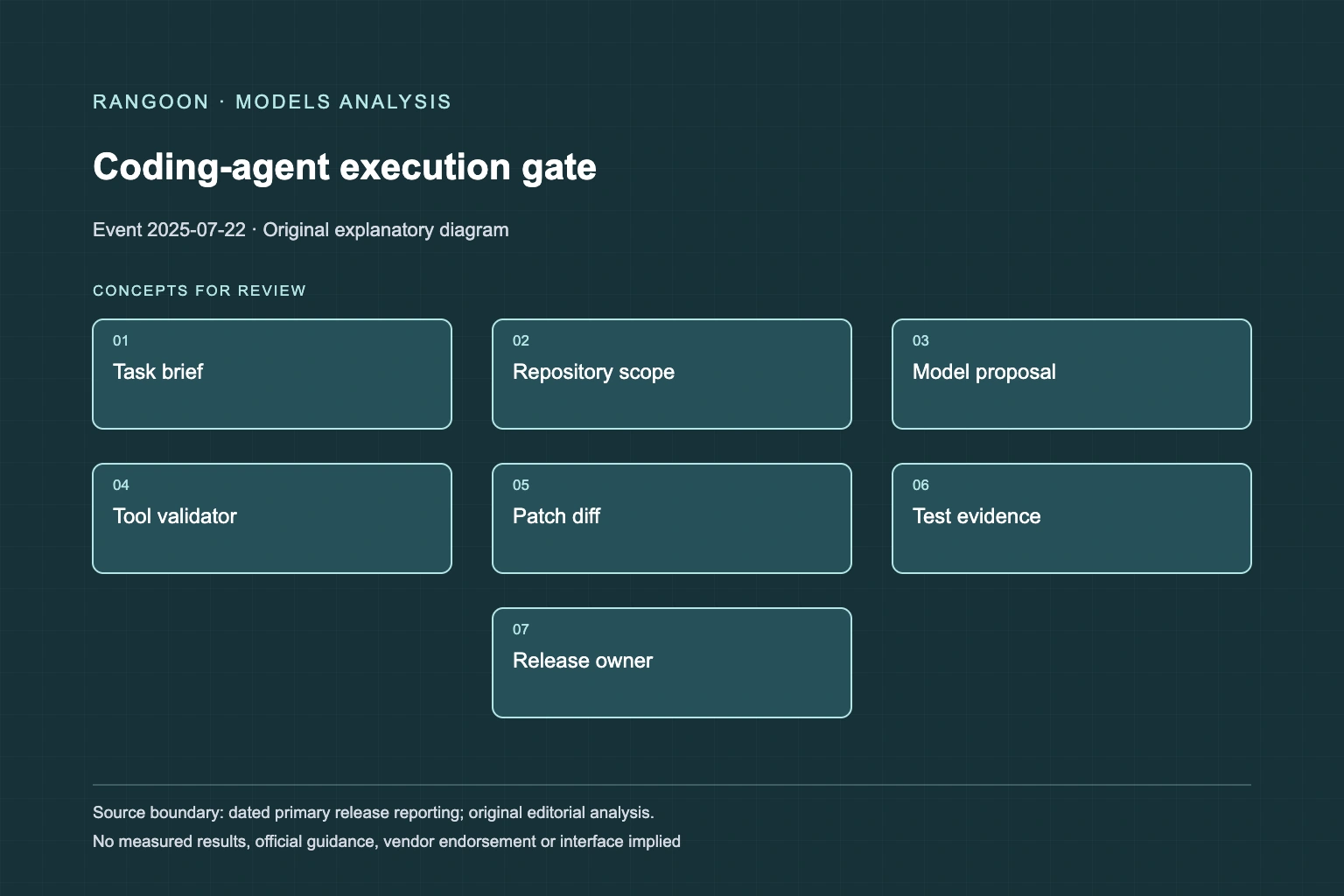
Key takeaways
- Qwen3-Coder’s release combined a model artifact with a command-line agent, so both model behavior and tool permissions require review.
- Large context does not replace repository selection, dependency provenance, test evidence or a human release owner.
- Tool calls should be treated as proposed effects with typed inputs, scoped credentials and recorded results.
The July release joined a MoE checkpoint and a command-line agent[source 1][source 2]
On July 22, 2025, Qwen announced Qwen3-Coder and introduced Qwen3-Coder-480B-A35B-Instruct as its first highlighted variant. The launch post described a 480B-parameter mixture-of-experts model with 35B active parameters, a native 256K-token context and optional extension to 1M tokens through YaRN. It also announced Qwen Code, an open-source command-line tool adapted from Gemini Code with prompts and function-calling protocols for Qwen3-Coder.
The corresponding model card records 160 experts, eight activated experts, 62 layers and grouped-query attention, and identifies the checkpoint as non-thinking mode only. It also names 262,144 tokens as the native context limit, which is a model setting rather than a guarantee that a host can load a whole repository. Those artifact-specific attributes matter to compatibility, memory planning and prompt handling, but they do not determine whether a generated patch is correct. A story about the event should therefore separate the published checkpoint, the Qwen Code tool and later community integrations rather than collapse them into one product claim.
Agentic coding shifts risk from completion text to proposed effects[source 1][source 2]
A coding model can write plausible source without having authority to inspect secrets, modify a release branch, install packages or invoke a deployment command. An agent runner should expose a small tool allowlist with exact working directories, typed parameters, output limits and explicit refusal paths. Reads, edits, test runs and external calls deserve different controls because their reversibility, data access and failure modes differ.
The model card includes a function-calling example and describes agentic coding support. That is a useful interoperability signal, not evidence that a tool payload is safe to execute. Each declared tool should return a bounded, machine-readable result so the model cannot convert a large log or a secret into a new prompt. A host should validate arguments before execution, redact sensitive tool output, bind writes to a diff, keep command logs, and require a separately authorized gate for network, credential, production or irreversible operations.
Repository-scale context still needs repository-scale verification[source 1][source 2]
Qwen described code reinforcement learning around tasks that are hard to solve and easy to verify, and published comparative agentic coding and tool-use results. Those are supplier claims under specified training and evaluation settings. They do not show that an agent will understand an unfamiliar repository’s hidden invariants, operational policy, generated files, schema ownership or customer-impacting paths.
A useful acceptance harness starts from a known revision and a narrow issue, then checks the proposed diff, formatting, focused tests, broader affected tests and review findings. It should save the model and tool versions, selected files, prompt policy, command transcript and final validator output. A reviewer can then reproduce the narrow case or reject the change with evidence rather than inferring quality from a fluent explanation. This makes failure analysis possible when an agent chooses an incomplete scope, invents an API, changes an unrelated file or produces a patch that compiles but violates product intent.
Sources
Continue reading
Related reading
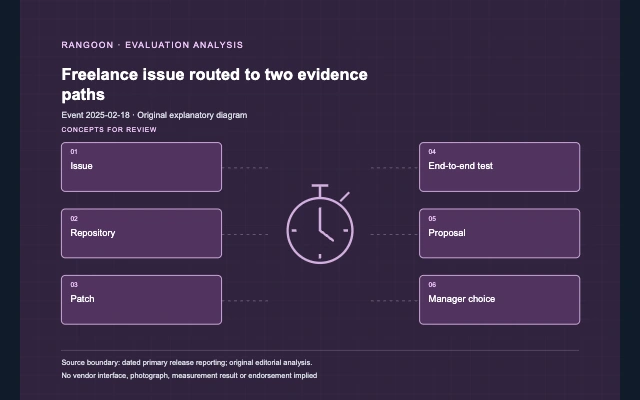 News analysisOpenAI introduced SWE-Lancer to test coding agents against freelance software work3 min read
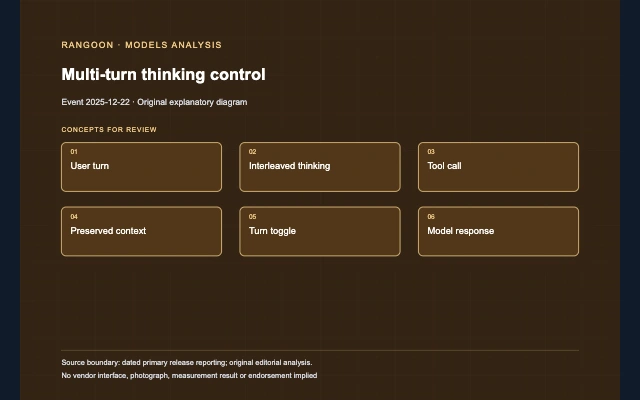 News analysisGLM-4.7 made preserved thinking a named control for multi-turn coding agents3 min read
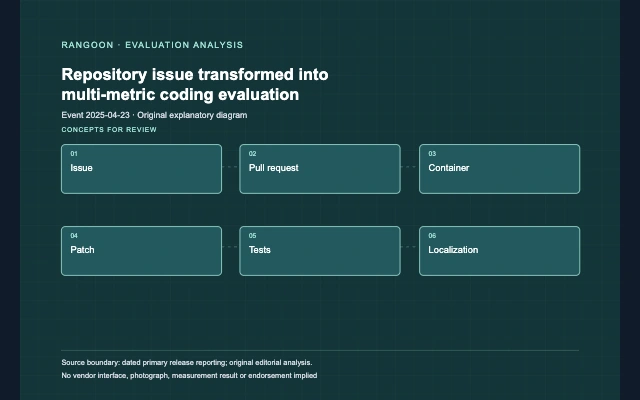 News analysisAmazon introduced SWE-PolyBench to broaden coding-agent evaluation beyond Python repositories3 min read