

America’s AI Action Plan made federal execution a three-pillar evidence problem
The White House released America’s AI Action Plan on July 23, 2025, framing more than 90 actions across innovation, infrastructure, and diplomacy and security.
Historical reporting: the White House release dated July 23, 2025 announced America’s AI Action Plan and described more than 90 actions. This article describes the plan as a policy document, not proof that a listed action was completed or that any programme applies to a specific reader.
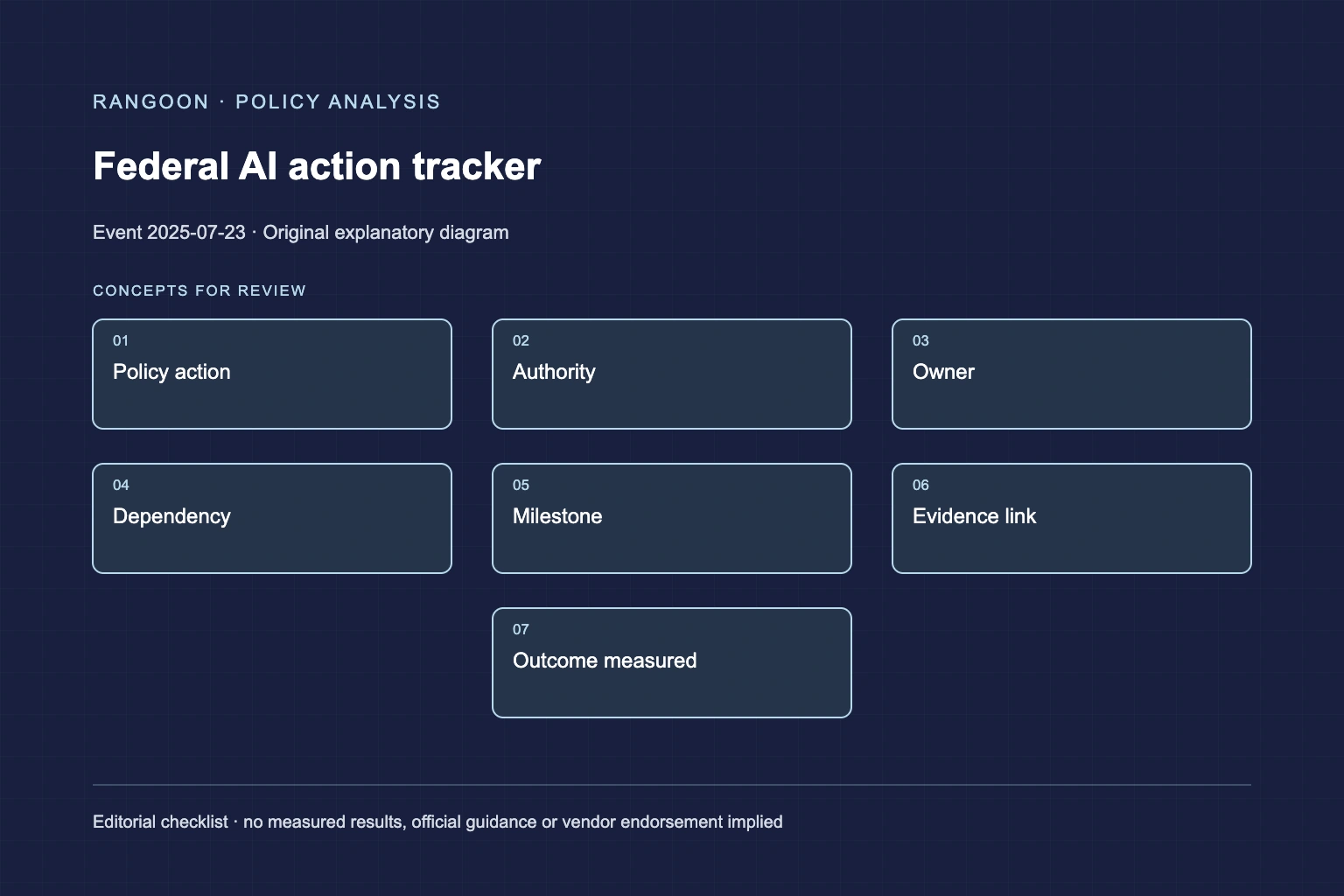
Key takeaways
- The plan named policy actions; it did not itself prove delivery, funding or local applicability.
- Innovation, infrastructure and international policy create different owners and evidence needs.
- A programme tracker should distinguish a stated action from a completed, measured outcome.
The release grouped federal intentions into three pillars[source 1][source 2]
On July 23, 2025, the White House released “Winning the Race: America’s AI Action Plan.” Its announcement said the plan identified more than 90 federal policy actions under three pillars: accelerating innovation, building American AI infrastructure, and leading in international diplomacy and security. It highlighted possible work on AI export packages, data-center and semiconductor permitting, workforce needs and federal procurement guidelines.
The accompanying plan document is a policy roadmap. Its table of contents spans innovation, infrastructure and international-security themes, including evaluations, government adoption, energy, semiconductor manufacturing and export-control enforcement. A roadmap can be significant evidence of executive-branch direction while remaining different from a final rule, appropriation, contract award, operating facility or measured programme result.
Three pillars imply three different delivery records[source 1][source 2]
Innovation actions need evidence about research, standards, adoption pilots, testing and programme ownership. Infrastructure actions need site, power, permitting, supply-chain, workforce and construction records. International and security actions need the relevant diplomatic, export-control, procurement or security authority. Combining them in one “AI plan complete” status hides the distinct prerequisites and responsible institutions.
A practical tracker gives every proposed action an owner, source citation, authority type, dependencies, next verifiable milestone and public evidence link. Its status vocabulary should separate announced, proposed, issued, funded, contracted, underway, completed and outcome measured. The labels are operational bookkeeping; they do not decide legal effect or claim a source agency’s endorsement.
Analysis: require a workload record before federal adoption claims[source 1][source 2]
The plan’s breadth does not replace workload evaluation. Before calling an AI system useful for a public mission, name the task, users, data classes, human decision, error consequences, uptime target and procurement route. Test expected and adverse cases, including abstention, source failure and a changed prompt or tool. Then retain the input version, configuration, results and responsible reviewer.
This record makes competing proposals comparable. One supplier may promise faster models, another local capacity, and a third a managed workflow; none of those descriptions states whether a system meets a specific public-service requirement. Analysis should keep programme rhetoric, acquisition terms and empirical results separate.
Analysis: use the plan as a dated signal, not current-status proof[source 1][source 2]
The July 2025 release established a policy event. It did not establish the subsequent status of every action, current regulations, appropriations, procurement eligibility or physical project. Each claim needs its own dated primary receipt. This distinction is particularly important where an action calls for multiple agencies, a later rulemaking, congressional funding or a private-sector build.
For readers planning work, preserve the plan’s publication date, quote little, link the primary pages and state what remains unverified. That keeps historical reporting clear and avoids presenting policy analysis as advice about a particular contract, export, permit or federal programme.
Sources
- White House: White House Unveils America’s AI Action Plan (July 23, 2025)
- White House: America’s AI Action Plan (July 23, 2025)
Continue reading
Related reading
 News analysisExecutive Order 14179 reset an AI policy direction and ordered an action plan3 min read
 News analysisFDA’s January AI-device lifecycle draft asked sponsors for an evidence trail, while remaining nonbinding and open for comment3 min read
 News analysisBritain’s AI Opportunities Action Plan paired 50 recommendations with a government response4 min read