A pre-publication training report made its status part of the copyright story
The U.S. Copyright Office posted a pre-publication version of Part 3 on May 9, 2025, examining copyright questions around generative-AI training without creating a new law.
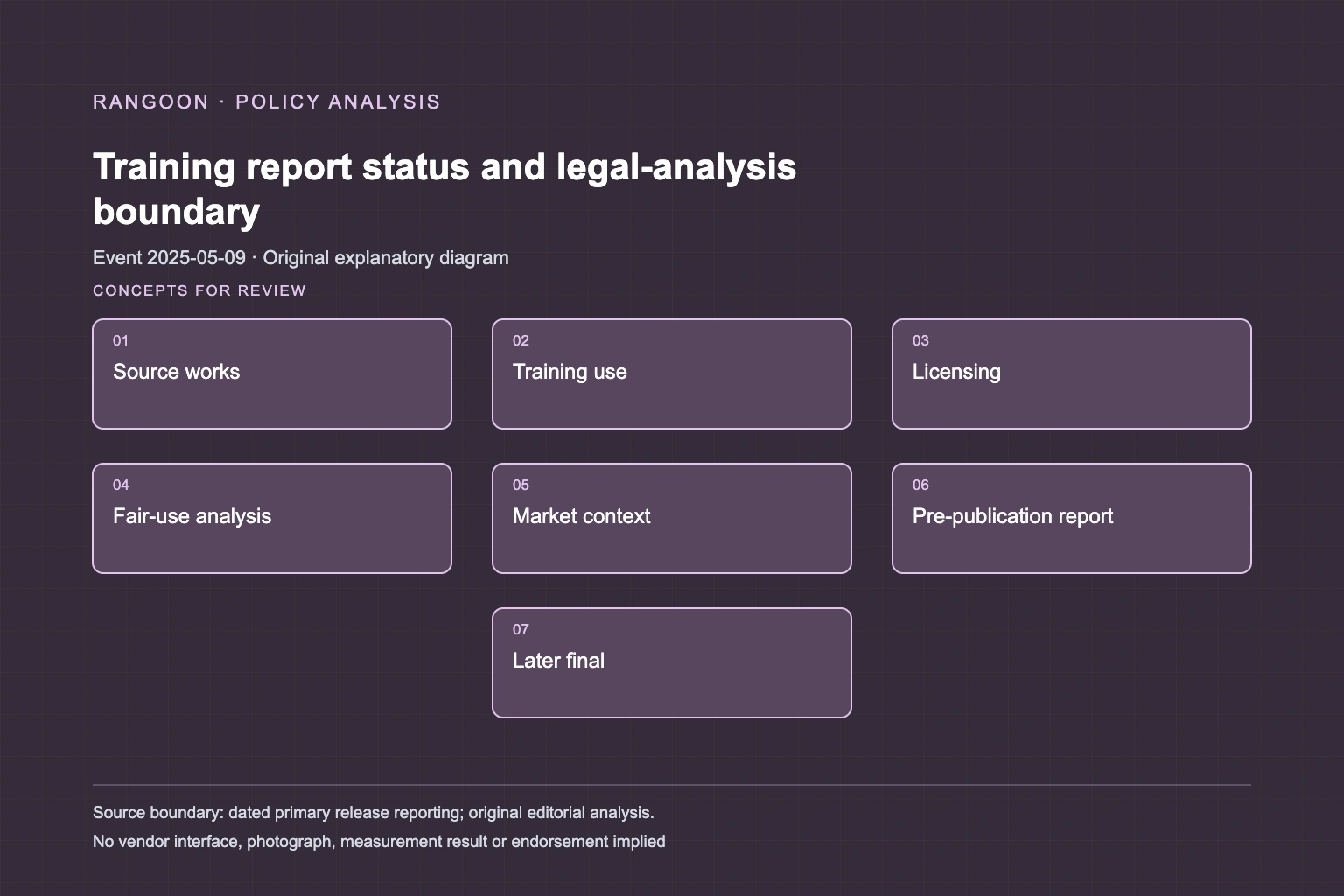
Historical reporting: on May 9, 2025, the U.S. Copyright Office released a pre-publication version of Part 3 of its AI report in response to congressional inquiries and stakeholder interest. The Office’s AI hub describes Part 3 as Generative AI Training and says a final version will follow without expected substantive changes to its analysis or conclusions. The pre-publication report is analysis, not a statute or final judicial determination.
Key takeaways
- Part 3 put the use of copyrighted works in generative-AI training into a dedicated Copyright Office report.
- Its May release was expressly pre-publication, making document status part of accurate reporting on the event.
- The report’s fair-use discussion is case-sensitive analysis, not a universal clearance or infringement finding.
The May event released a training analysis before its final publication[source 1][source 2]
The U.S. Copyright Office released a pre-publication version of Part 3, Generative AI Training, on May 9, 2025. Its AI hub says the Office did so in response to congressional inquiries and stakeholder interest, while a final version would be published later. That status is central to the event: this was not the enactment of a training-data rule or a final court judgment. It made the Office’s analysis available for public examination while preserving the distinction between the pre-publication document and later legal developments.
The report treated training as a chain of copyright questions[source 1][source 2]
Part 3 examines the use of copyrighted works to develop generative AI, including the reproduction involved in assembling and using training material. Its analysis addresses licensing, fair use, market effects, and the practical difficulty of tracing material through large-scale model development. Those topics do not collapse into a yes-or-no answer based on whether a model can generate a similar output. The report instead treats the purpose of a use, the character of the source material, and the surrounding market context as part of a legal analysis that depends on specific circumstances.
The training discussion distinguished transformative purpose from market substitution[source 1][source 2]
The report’s value is in showing why training disputes cannot be reduced to a model’s parameter count or a dataset label. A use can involve technical transformation while still raising questions about the scale and source of copied works, the availability of licenses, and downstream competition with protected expression. The Office discussed situations in which training may be fair use as well as circumstances where commercial use of large collections can press beyond established fair-use boundaries. It also treated licensing markets as a live issue, which makes the analysis sensitive to how works are obtained and what uses a model enables. This is a map of considerations that can change with a model, use, and market; it is not a declaration that every model-training practice is permitted or prohibited.
The document’s timing limits what the event itself can establish[source 1][source 2]
Calling the May document a final rule would erase its stated status and overstate the Office’s authority. The report does not create a private license, resolve pending litigation, or decide whether a particular dataset was lawfully used. Its narrower contribution is a public policy record that gathers legal questions around generative-AI training ahead of the Office’s stated future final version. It keeps the event’s document status from being mistaken for a new regulatory regime. For product teams and researchers, the news is the release of that analytical record and its limits, not a compliance verdict for a model or data pipeline.
Sources
Continue reading