

Groq licensed inference technology to Nvidia while remaining an independent company
Groq announced a non-exclusive Nvidia licensing agreement on December 24, 2025 for its inference technology, while saying Groq and GroqCloud would continue operating independently.
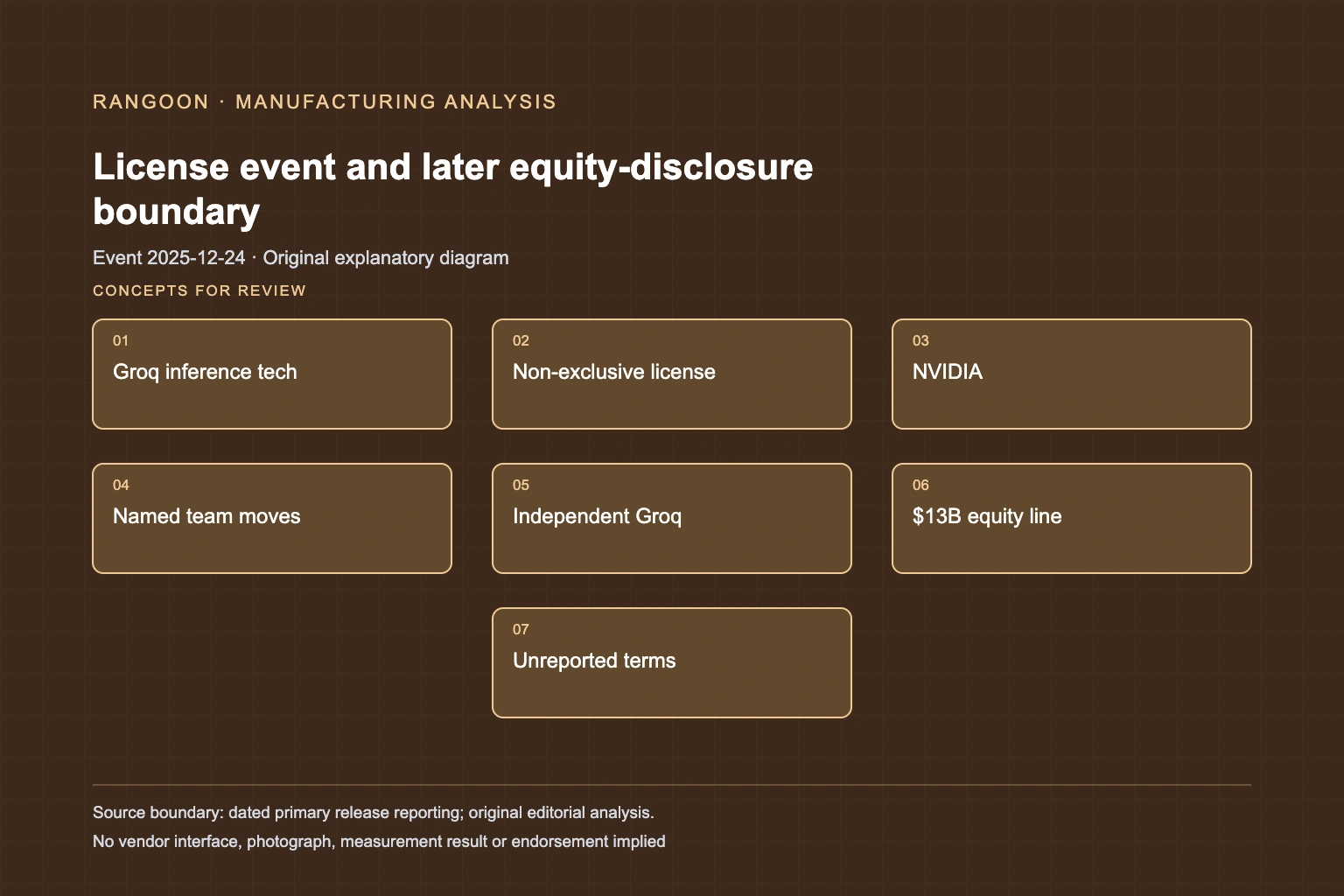
Historical reporting: Groq announced a non-exclusive licensing agreement with Nvidia for Groq inference technology on December 24, 2025. Groq said it would remain an independent company and that GroqCloud would continue without interruption, while named leaders and other team members would join Nvidia. A later NVIDIA FY2026 disclosure lists Groq, Inc. as a $13.0 billion purchase of non-marketable equity securities. That later disclosure evidences a listed equity purchase, but does not state a stake percentage, license price, acquisition, integration plan or closing date.
Key takeaways
- The December record describes a non-exclusive license for inference technology, not Nvidia acquiring Groq as a company.
- Groq said its company and GroqCloud would continue operating, while some leaders and team members joined Nvidia.
- A technology license does not by itself specify product integration, hardware availability, economics or future service behavior.
Groq described a license with a stated non-exclusive scope[source 1][source 2]
On December 24, 2025, Groq announced a non-exclusive licensing agreement with Nvidia for Groq’s inference technology. The company framed the agreement around expanding access to high-performance, low-cost inference. Non-exclusive is a material qualifier: the announcement described permission to use licensed technology, not a statement that Groq’s technology or business had become exclusive Nvidia property. The public wording does not say that intellectual property was sold, identify every licensed component, or name a product that would use it. The historical record therefore starts with the contract form Groq named, rather than rephrasing it as an acquisition.
The announcement paired personnel moves with continuing Groq operations[source 1]
Groq said founder Jonathan Ross, president Sunny Madra and other team members would join Nvidia to help advance and scale the licensed technology. In the same announcement, Groq said it would continue to operate as an independent company under a new chief executive and that GroqCloud would continue without interruption. Those statements place the staffing changes beside an explicit operating-status claim. They also distinguish the announced continuity of a cloud service from any claim about its future capacity, models, pricing or roadmap. The announcement does not disclose what functions moved, what technology would be integrated first, or how each company would make future product decisions.
Inference technology is a narrower subject than an entire AI company[source 1][source 2]
Inference is the phase in which a trained model is used to produce outputs, and its technical constraints can differ from training infrastructure. Licensing inference technology can cover valuable hardware, software or design know-how without describing every asset, service or customer relationship a company has. A licensed design still needs a concrete implementation, surrounding software and an available service or device before users can consume it. That distinction is important for compute reporting because a license may influence future systems without making those systems available on the announcement date. The agreement’s significance lies in the stated technology scope and non-exclusive structure, while implementation details remain outside the public wording.
A later financial disclosure added an equity-purchase record without changing the license event[source 1][source 2]
Nvidia’s later fiscal 2026 financial-results table lists Groq, Inc. as a $13.0 billion purchase under non-marketable equity securities. That is evidence of a listed equity purchase and must be kept separate from Groq’s December announcement of a non-exclusive technology license. The disclosure does not state the percentage acquired, price assigned to the license, exclusive rights, a product-integration plan or a closing date. Nor does either primary record identify Nvidia as acquiring Groq as a company. The December news event remains the announced license and continuing Groq operations; the later financial table adds a distinct equity-record fact rather than filling in unreported transaction terms.
Sources
Continue reading
Related reading
 News analysisTensorRT-LLM 0.17 added Blackwell and an experimental PyTorch workflow3 min read
 News analysisNVIDIA Dynamo replaced the unsupported Docker Sandboxes prompt with a verifiable reasoning-models inference event3 min read
 News analysisNVIDIA’s memory codesign post highlights a practical boundary between capacity and usable agent throughput3 min read