

NVIDIA Dynamo replaced the unsupported Docker Sandboxes prompt with a verifiable reasoning-models inference event
NVIDIA introduced Dynamo in March 2025 as open-source inference-serving software, offering a documented replacement for an unsupported Docker Sandboxes historical event.
Replacement note: no dated primary Docker Sandboxes event could be verified for the supplied early-2026 topic. This article instead records NVIDIA Dynamo’s March 18, 2025 primary-source launch.
Key takeaways
- Dynamo was announced as inference-serving software, not a model benchmark.
- KV-cache-aware routing needs workload-specific latency and reuse measurement.
- Disaggregated serving changes failure domains and capacity planning.
NVIDIA introduced Dynamo as an open-source serving layer[source 1][source 2]
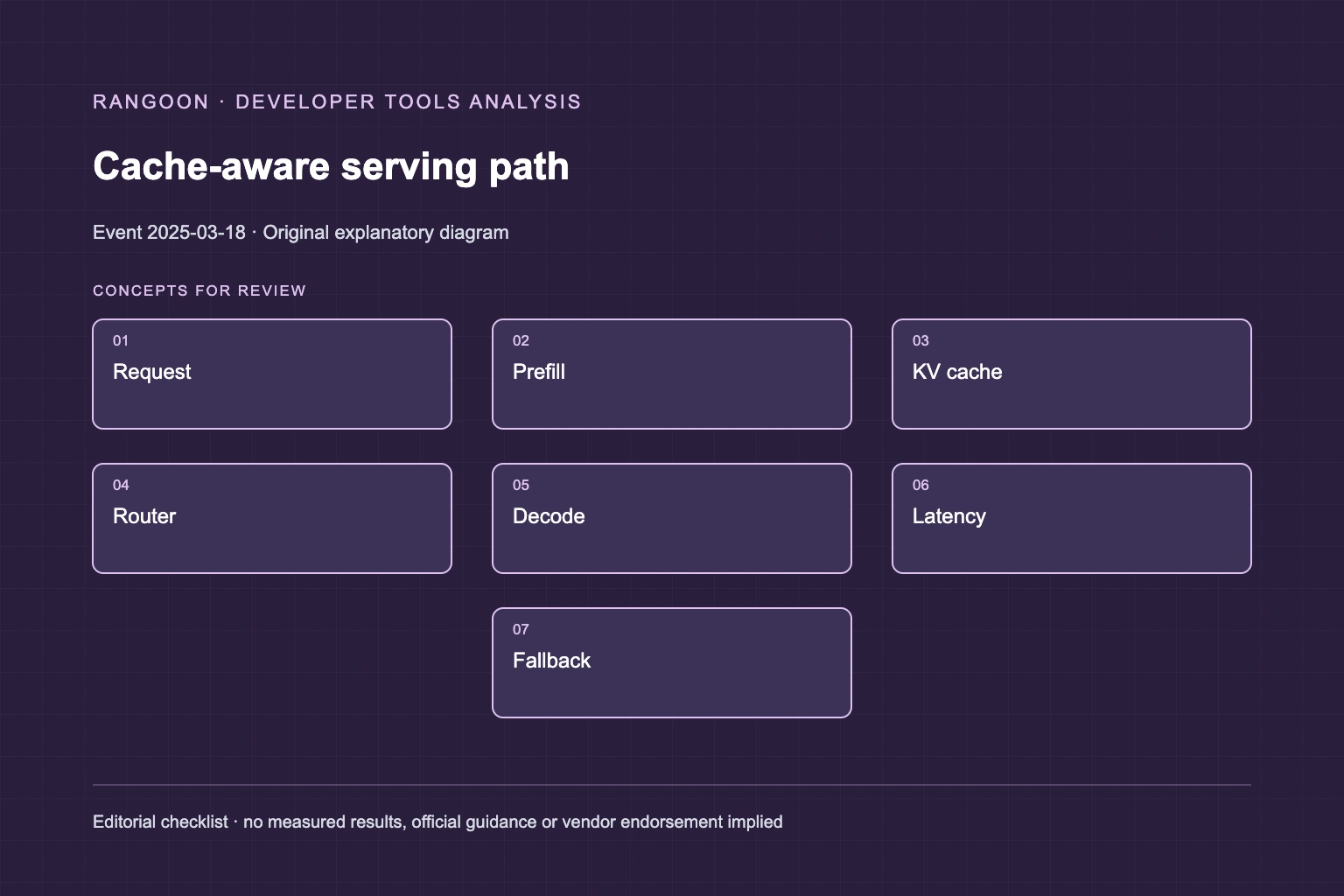
NVIDIA announced Dynamo at GTC on March 18, 2025, describing open-source software for reasoning-models inference serving and calling it the successor to Triton Inference Server. The primary announcement connected Dynamo to disaggregated serving and KV-cache-aware request routing. NVIDIA’s March 16, 2026 Dynamo 1.0 release later described a production-grade open-source foundation. This article anchors the historical event to the March 2025 launch. The supplied Docker Sandboxes topic was replaced because a dated primary launch within the requested range was not verified.
The reasoning-models qualifier matters because long chains of generated tokens create different resource pressure from short answers. NVIDIA’s launch framed Dynamo around serving infrastructure, not a new foundation model. That distinction keeps model quality claims separate from the scheduler, memory and traffic-control questions raised by the runtime announcement.
KV-cache-aware routing makes request placement a systems decision[source 1][source 2]
Inference servers spend resources on prefill, decode, batching, memory management and queueing, not only model arithmetic. When a serving system routes requests using cached context, traffic shape and prompt reuse influence performance. Disaggregating prefill and decode can improve utilisation for some workloads while adding network, scheduling and recovery complexity. A provider’s architectural claim is not a performance result for your prompt lengths, models, GPU topology, concurrency or tail-latency objective.
Dynamo 1.0’s later description of GPU-and-memory orchestration and moving data to lower-cost storage illustrates why an inference runtime should be reviewed as a distributed system. Memory movement, cache ownership and routing may alter fault domains even when clients see one API. A capacity design must therefore include network and storage observations, not only GPU utilization.
Serving evaluation needs cold, warm and failure traffic[source 1][source 2]
Measure time to first token, completion rate, per-token latency, queue delay, cache hit rate, GPU memory, error rate and cost under declared traffic. Split cold requests from repeated-prefix requests, because cache reuse can make an average look better than a first-use experience. Include load spikes, a worker loss and an incompatible model artifact. Preserve hardware, driver, runtime, precision, batch policy and input distribution alongside every result.
For reasoning-models workloads, add a maximum completion length and a cancellation test. Long outputs can occupy decode capacity long after a user abandons a request. Measure whether cancellation releases memory and scheduling slots promptly, and whether an interrupted response is marked incomplete rather than being reused as a finished reasoning result.
Analysis: capacity plans must model cache locality explicitly[source 1][source 2]
If cache-aware routing is part of an inference design, record how cache residency is bounded, evicted, isolated by tenant and recovered after failure. Do not infer a benefit from a benchmark whose reuse pattern differs from production. A small canary with replayed but privacy-safe traffic can establish whether the routing policy helps; it should also define the fallback when cache locality disappears. This is original systems analysis, not a claim about Dynamo’s current release.
A canary should compare two traffic mixes: repeated conversational turns and unrelated first-time prompts. If only the former improves, report that limitation rather than treating a blended average as universal savings. This gives product owners a decision tied to their request distribution, and it prevents infrastructure claims from masking a cold-start regression.
Sources
- NVIDIA: Dynamo open-source reasoning-models inference announcement (March 18, 2025)
- NVIDIA: Dynamo 1.0 production release (March 16, 2026)
Continue reading
Related reading
 News analysisNVIDIA’s memory codesign post highlights a practical boundary between capacity and usable agent throughput3 min read
 News analysisTensorRT-LLM 0.17 added Blackwell and an experimental PyTorch workflow3 min read
 News analysisGroq licensed inference technology to Nvidia while remaining an independent company3 min read