

ServiceNow signed for Moveworks, then closed the enterprise-search acquisition nine months later
ServiceNow signed a definitive agreement for Moveworks on March 10, 2025 and completed the acquisition on December 15, joining workflow automation with an AI assistant.
Historical reporting: ServiceNow announced a definitive agreement to acquire Moveworks on March 10, 2025, then announced completion on December 15, 2025. The first record is an agreement, not a closing; the later record confirms the acquisition closed. The companies described a planned combination of ServiceNow workflows with Moveworks’ AI assistant, enterprise search and reasoning engine. Product benefits, integration sequence, adoption figures and outcome statements are vendor claims or forward-looking statements, not proof that a particular customer received a feature, completed a workflow correctly or achieved a result.
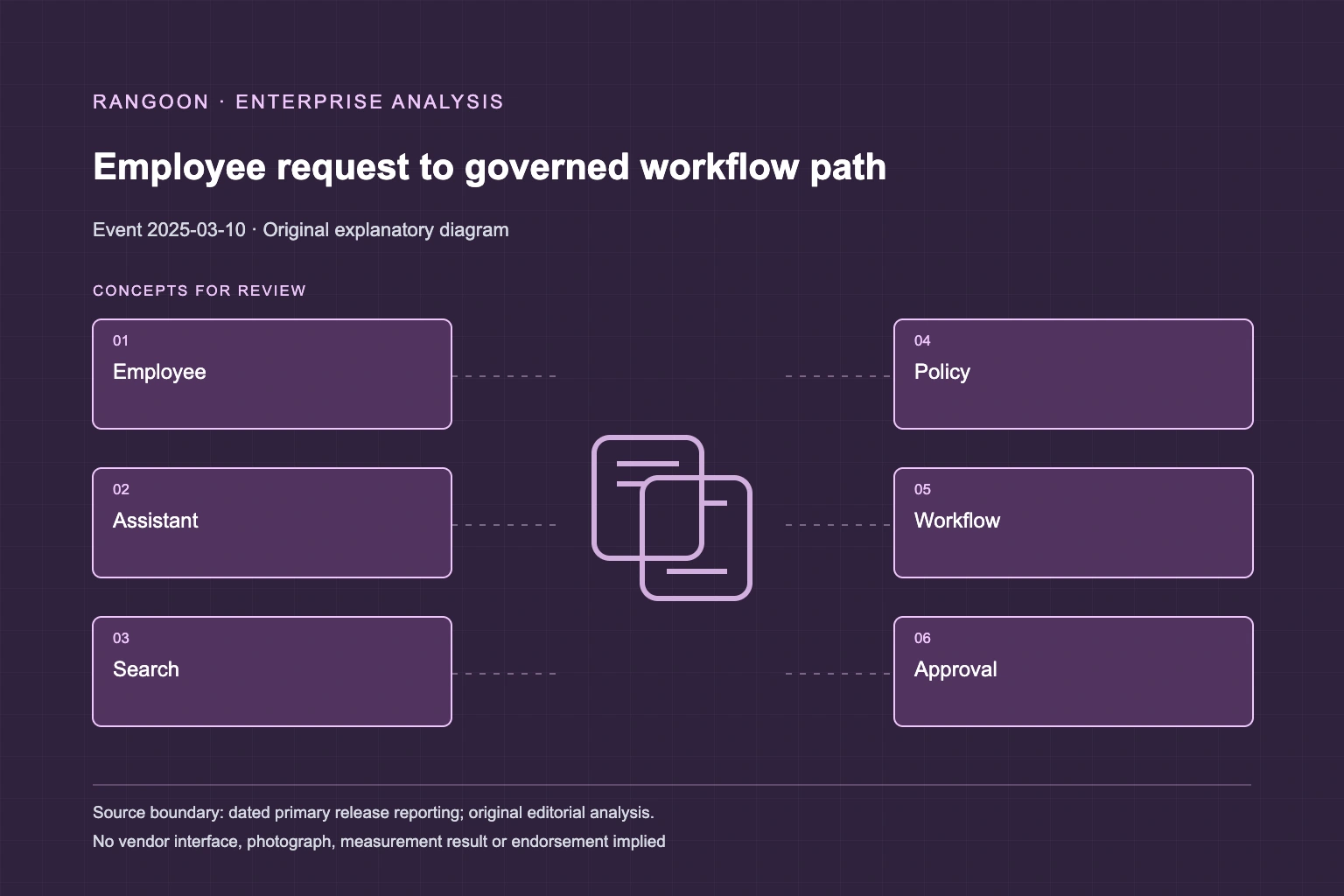
Key takeaways
- March 10 recorded a signed definitive agreement; ServiceNow did not report the deal as closed until December 15.
- The announced technical rationale joined a conversational employee entry point with ServiceNow workflow and agent capabilities.
- A combined assistant, search layer and workflow platform still needs separate tests for permissions, source quality and action approval.
The March release described a signed transaction rather than a completed acquisition[source 1]
On March 10, 2025, ServiceNow announced that it had signed a definitive agreement to acquire Moveworks. Its release described the proposed combination as bringing ServiceNow’s agentic AI and automation together with Moveworks’ front-end AI assistant and enterprise-search technology. The wording matters: a definitive agreement sets out an intended transaction subject to its stated closing process. It does not show that legal ownership had transferred, that teams had been integrated, or that a shared product was available to customers. ServiceNow’s March record also framed the transaction around employee experiences and workflow automation. That is a useful account of the buyer’s stated rationale, but it should not be converted into a claim that every employee request could already reach an autonomous workflow.
ServiceNow’s December release supplies the later closing date[source 1][source 2]
ServiceNow announced on December 15, 2025 that it had completed the Moveworks acquisition. The closing release describes Moveworks as contributing an AI assistant, enterprise search and an agentic reasoning engine to ServiceNow’s platform, while presenting the combined offer as an AI-native front door for employee engagement. This later announcement resolves the central transaction status question left open by the March agreement: the acquisition had closed. It does not establish that every planned integration had shipped on the closing date. A closing can change ownership and product planning while interface work, identity mapping, data migration, entitlements and support arrangements continue on their own schedules. The historical sequence is therefore agreement first, completion later, and product delivery evidence separate from both.
The releases described distinct request, search and workflow roles[source 1][source 2]
ServiceNow’s descriptions distinguish several layers that are often collapsed into a generic enterprise-AI claim. Moveworks was presented as an employee-facing assistant and enterprise-search layer; ServiceNow emphasized agents, automation and intelligent workflows. In a real request path, locating information, interpreting a request, selecting a workflow and executing a permitted action are different operations. Search can return a stale or over-broad source, a model can misunderstand the request, and a workflow may require an identity or approval that the conversational layer does not possess. The acquisition announcements explain why the vendors saw those layers as complementary. They do not document a universal connector inventory, an authorization model, a source-freshness guarantee or a correct-action rate for a customer deployment.
The acquisition record supports transaction facts and stated direction, not an automation guarantee[source 1][source 2]
The two ServiceNow records support a narrow, dated account: ServiceNow signed for Moveworks in March and completed the acquisition in December. They also record the buyer’s stated plan to combine conversational assistance, enterprise search, agents and workflows. The releases contain forward-looking language and vendor outcome claims, so they are not independent proof that an integration reduces cost, resolves a ticket correctly or safely acts across a company’s systems. An operator evaluating such a stack would still need a source-access inventory, identity boundaries, tool scopes, approval points, audit records and tests for ambiguous requests. Those controls are needed even when the assistant and workflow supplier share an owner. The acquisition itself changes corporate structure; it does not grant an AI response authority to search private content or execute a consequential action.
Sources
- ServiceNow Newsroom: ServiceNow to acquire Moveworks (March 10, 2025)
- ServiceNow Newsroom: ServiceNow completes acquisition of Moveworks (December 15, 2025)
Continue reading
Related reading
 News analysisServiceNow’s Yokohama release put preconfigured AI-agent teams into business workflows3 min read
 News analysisWorkday signed for Sana’s search, agents and learning products, then completed the acquisition in November3 min read
 News analysisUiPath launched an agentic-automation platform spanning agents, robots and people3 min read